EICR Report Example: What a Professional Report Should Show
EICR report example with fictional readings, observations and limitations. See…

Written by
Michael Adrian
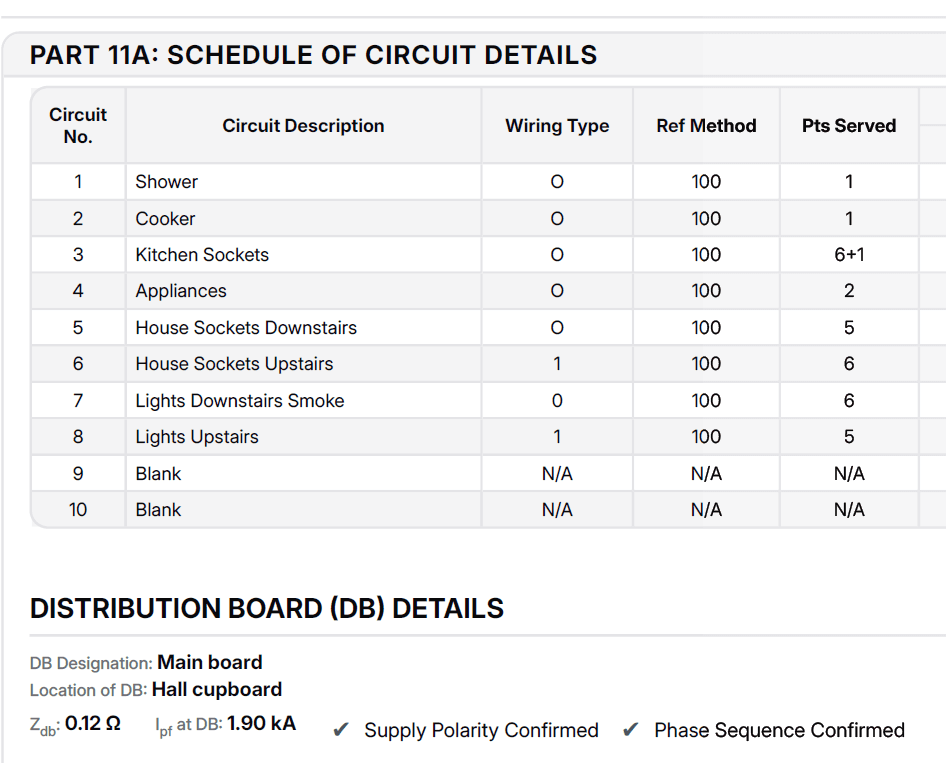
Circuit Schedule
EICR Report Example: What a Professional Report Should Show
An EICR report is not made professional by looking tidy. It needs to show what was inspected, what was tested, what was inaccessible, what was found and how the final conclusion follows from the evidence.
The example below is fictional. The names, address, circuit details, readings and observations are made up to show how the parts of a report fit together. It is not an official IET certificate, a blank form or a report that can be copied and issued on site.
The IET model forms are the reference for the current form structure. Use the current form, BS 7671, Guidance Note 3 and your normal inspection and testing procedures for real work.
What a complete EICR report should contain
A useful report lets another competent person understand the inspection without having to guess. The exact fields and tests depend on the installation and the agreed scope, but a complete report normally brings these parts together:
| Report section | What it should make clear | Common red flag |
|---|---|---|
| Client and installation details | Who ordered the report, where the installation is and what type of premises it is | Generic property details or a report with no clear installation identity |
| Reason and date | Why the inspection was commissioned and when it took place | A report that cannot be tied to a visit or instruction |
| Extent and limitations | What was included, what could not be checked, why and with what consequence | “Not applicable” used to hide an inaccessible area |
| Schedule of inspections | The inspection checks carried out and any relevant not-inspected or not-applicable entries | Every line treated as a tick-box exercise regardless of the installation |
| Schedule of test results | Circuit references, protective devices, relevant conductor details and measured results | Readings with no circuit identity or comparison basis |
| Observations | A specific defect, its location, relevant reference and classification | “Unsafe wiring” with no location or usable description |
| Summary and declaration | The overall outcome, recommendations, signatures and dates | A satisfactory conclusion that does not agree with the observations |
The IET inspection and testing FAQs explain the role of observations and classification. The report is a record of the installation inspected at that time and within that scope. It is not a guarantee that every concealed part is safe or that the installation will remain in the same condition.
Fictional EICR example: scope and limitations
Here is the fictional front end of the report.
Installation details
- Client: Northbank Lettings Ltd
- Installation: 14 Example Street, Aberdeen, AB1 2CD
- Premises: Two-bedroom domestic dwelling
- Reason for report: Periodic inspection for landlord records
- Date of inspection: 4 September 2026
- Inspector: A. Inspector, Example Electrical Services
- Supply: 230 V single phase, 50 Hz
- Earthing arrangement: TN-C-S, as identified at the origin
- Main protective device: 100 A service cut-out
- Main earthing conductor: 16 mm² copper, recorded at the origin
- Main bonding: Water and gas bonding present and accessible at the time of inspection
- Report basis: Current EICR model-form structure and the agreed inspection scope
Extent of inspection
The report covers the consumer unit, visible wiring systems and accessories, the accessible fixed wiring installation, the listed final circuits and the accessible earthing and bonding arrangements. Accessories were removed only where this was safe and within the agreed inspection procedure.
The following limitations were recorded:
| Limitation | Why it existed | Consequence |
|---|---|---|
| Floor coverings not lifted | The client did not authorise lifting carpets or laminate | Wiring concealed beneath those finishes was not visually inspected |
| Kitchen appliances not disconnected | Occupied property and no agreement to disconnect fixed appliances | Connections behind the appliances were not inspected; the report does not claim they were satisfactory |
| Loft insulation left in place | Insulation could not be disturbed safely during the visit | Parts of the cable routes remained concealed and were assessed only from accessible evidence |
That is stronger than writing “full inspection” and quietly leaving inaccessible areas unmentioned. A limitation should tell the reader what was not checked and why it matters. It is not the same as marking an item N/A. N/A means the item does not apply to the installation or scope. A limitation means it may apply, but the inspection could not establish its condition.
Example Schedule of Inspections
The table below shows representative records from the fictional inspection. It is not a reproduction of the IET schedule and is not intended to list every possible row.
| Area or check | Example record | Comment |
|---|---|---|
| Intake and consumer unit | Inspected | Enclosure secure; labels present; one unused way blanked |
| Main earthing and bonding | Inspected | Main earthing terminal and accessible bonding connections checked |
| Consumer-unit connections | Inspected where accessible | No heat damage seen; protective-device identification recorded |
| Fixed wiring and accessories | Inspected visually where accessible | Bedrooms and living areas accessible; kitchen appliance connections excluded as stated above |
| Socket outlets and switches | Inspected | Sample includes polarity and condition checks at accessible accessories |
| Bathroom and special location | Inspected within accessible scope | Supplementary bonding arrangement and accessories recorded where present |
| Loft cable routes | Limited | Insulation left in place; concealed sections not visually confirmed |
The useful question is not “does every box have a tick?” It is “does the schedule describe the inspection that actually happened?”
Example Schedule of Test Results
These are fictional sample values only. They demonstrate how results can be presented with circuit identity and protective-device context. They are not universal pass values and must not be used to judge a real circuit without the installation details, applicable requirements, test method and competent engineering judgement.
| Circuit | Protective device | Cable recorded | Continuity R1+R2 | Insulation resistance | Polarity | Zs | RCD result |
|---|---|---|---|---|---|---|---|
| C1 lighting | B6 MCB | 1.5 mm² T&E | 1.12 Ω | >200 MΩ | Correct | 1.36 Ω | N/A |
| C2 upstairs sockets | B32 RCBO, 30 mA | 2.5 mm² T&E | 0.48 Ω | >200 MΩ | Correct | 0.71 Ω | 24 ms at 1× IΔn |
| C3 kitchen sockets | B32 RCBO, 30 mA | 2.5 mm² T&E | 0.55 Ω | >200 MΩ | Correct | 0.78 Ω | 28 ms at 1× IΔn |
| C4 cooker | B32 MCB | 6.0 mm² T&E | 0.31 Ω | >200 MΩ | Correct | 0.62 Ω | N/A |
| C5 immersion heater | B16 MCB | 2.5 mm² T&E | 0.64 Ω | >200 MΩ | Correct | 0.89 Ω | N/A |
The figures are useful because each reading is tied to a circuit and a protective device. A bare list of numbers is much harder to review.
The comparison is not “is every Zs below one number?” A test result has to be interpreted against the circuit, protective device, required disconnection time and applicable technical basis. The IET's explanation of maximum earth fault loop impedance for protective devices is useful background here.
The same principle applies to missing results. If a test was not carried out, the report should say so and give the reason where relevant. Do not fill a gap with a copied value from another circuit.
Example observations and EICR codes
The observation is where the report stops being a collection of readings and explains what the inspector found.
Example C2 observation
Location: Ground-floor hallway, under-stairs socket outlet
Observation: Socket outlet faceplate cracked, with live-accessible damage possible during normal use. Replace the damaged accessory and inspect the surrounding enclosure and terminations before re-energisation.
Classification: C2, potentially dangerous
This example gives the reader a location, a condition and a practical action. It does not pretend that the code can be selected from the word “cracked” alone. The actual classification depends on what was found, the risk and the inspector's judgement.
Example C3 observation
Location: First-floor bedroom, six-way socket circuit
Observation: No additional protection by a 30 mA RCD was identified for the existing socket circuit. The circuit remains operational, but improvement to the protective arrangement should be considered when alteration or replacement work is next undertaken, subject to the installation circumstances and applicable requirements.
Classification: C3, improvement recommended
This is deliberately qualified. It does not claim that one missing feature produces the same code in every installation. The Electrical Safety First Best Practice Guide 4 is the better reader-facing reference for classification guidance.
Vague wording versus usable wording
| Weak entry | Better entry |
|---|---|
| “Faulty socket” | “Ground-floor hallway, under-stairs socket: faceplate cracked with possible live-accessible damage during normal use. Replace accessory and inspect enclosure and terminations before re-energisation. C2.” |
| “No RCD” | “First-floor bedroom socket circuit: no additional 30 mA RCD protection identified. Existing circuit and installation circumstances recorded; improvement recommended when alteration or replacement is next undertaken, subject to applicable requirements. C3.” |
| “Loft not checked” | “Loft cable routes not visually inspected because insulation was not authorised to be disturbed. Concealed sections remain outside the confirmed visual scope.” |
The better entry is not necessarily longer. It is specific enough for the client, remedial electrician and future reviewer to understand what needs checking next.
How the example reaches its overall conclusion
The fictional report contains a C2 observation, so its overall conclusion is unsatisfactory until the dangerous condition is dealt with and the installation is reassessed as appropriate.
The C3 observation does not, on its own, make the report unsatisfactory. The code and the conclusion still need to be consistent with the installation facts, the scope and the current guidance. If the report contained only improvement recommendations classified C3, the conclusion would not automatically become unsatisfactory simply because a C3 appears on the page.
The limitation does not turn into a pass or fail code by itself either. It changes what the report can honestly claim. The summary should carry the limitation forward so that the client understands which concealed or inaccessible areas were not confirmed.
A useful consistency check is:
commissioned scope → accessible inspection → tests completed → observations classified → conclusion checked → report handed over
If the schedule shows a circuit as tested but the circuit does not appear in the circuit details, that is a report-quality problem. If the summary says “satisfactory” while a C2 remains recorded, that is an internal contradiction. If the scope excludes a section, the conclusion must not imply that section was inspected.
What the handover should include
The handover should give the client the completed report and enough information to act on it.
For this fictional example, that means:
- the completed EICR with the inspection date and installation identity;
- the recorded scope and limitations;
- the schedules of inspections and test results;
- the observations, locations and classifications;
- the overall conclusion and recommendations;
- a clear explanation that the C2 requires remedial attention;
- any agreed follow-up or retest arrangement;
- the relevant declarations, signatures, dates and report/version details.
For a private rented property in England, the landlord has separate duties under the Electrical Safety Standards in the Private Rented Sector guidance. Keep that jurisdiction-specific. Do not turn an England landlord paragraph into a claim about every UK property.
The form version also matters during the 2026 transition. State which form edition and date the example uses, and check the current IET wording before publication. Do not present a dated example as though it were a timeless official template.
Quick review checklist for an EICR report
Before accepting a report, check:
- Does the installation identity match the job and client instruction?
- Is the reason for the report and inspection date clear?
- Does the extent match what was actually inspected?
- Are limitations recorded with reasons and consequences?
- Are “not applicable” and “not inspected” being used accurately?
- Does every claimed test have a result, or a documented reason it was not possible?
- Do circuit identifiers, protective devices, conductor details and readings agree?
- Are results interpreted against the correct technical basis rather than a copied universal number?
- Are observations specific enough to locate and act on?
- Does each classification reflect the installation facts and engineering judgement?
- Does the conclusion follow from the observations and the scope?
- Are recommendations, signatures, dates and version details complete?
The EICR checklist is the useful companion for the inspection sequence. For classification detail, see EICR codes explained. If you are comparing ways to capture the work, the paper vs digital EICR workflow guide covers that decision separately.
This is the sort of evidence chain a structured reporting workflow should preserve: scope, limitations, circuit readings, observations and handover in one place. TestFast can help organise that record, but it does not make an inspection competent, choose a classification automatically or validate fictional sample values. The technical decision stays with the inspector.
FAQ
What does a real EICR report look like?
A real EICR identifies the installation and inspection scope, records limitations, shows the relevant inspection and test results, describes observations and classifications, and gives a conclusion that agrees with those findings. The exact fields and tests depend on the installation and agreed scope.
Is a blank IET model form an EICR example?
No. A blank model form shows the structure and fields. It does not show how a particular installation was inspected, what readings were obtained, what limitations applied or why a conclusion was reached. Use the IET model forms as the official form reference, not as a substitute for inspection evidence.
What test results should appear on an EICR?
The results appropriate to the installation and inspection scope should be recorded against identifiable circuits and protective devices. Depending on the circuit, that can include continuity, insulation resistance, polarity, earth fault loop impedance, prospective fault current and RCD results. There is no honest universal list detached from the installation, and a sample value is not a universal pass threshold.
Can an EICR be satisfactory with C3 observations?
It can be, where the recorded findings are properly classified C3 and the overall conclusion is consistent with the current form and applicable guidance. C3 means improvement recommended. It does not automatically make the report unsatisfactory. Borderline classifications still require competent judgement based on the installation facts.
What should be recorded if part of the installation could not be inspected?
Record what was excluded, why it could not be inspected and what that means for the report. Do not describe the installation as fully inspected if concealed or inaccessible parts were outside the agreed scope. The limitation should remain visible to the person relying on the report.
The practical takeaway
A professional EICR example is useful when it shows the logic of the report, not when it gives people another form to copy.
The test is simple: can another competent person see what was in scope, what was checked, what was measured, what was found and why the conclusion follows?
If the answer is yes, the report is doing its job. If the reader has to guess, the tidy layout is beside the point.
Ready to transform your EICR workflow?
Join hundreds of UK electricians who are saving hours on every report with TestFast.