EICR Codes Explained: C1, C2, C3 and FI in Plain English
EICR codes explained for UK electricians. Guidance on C1, C2, C3 and FI.

Written by
Michael Adrian
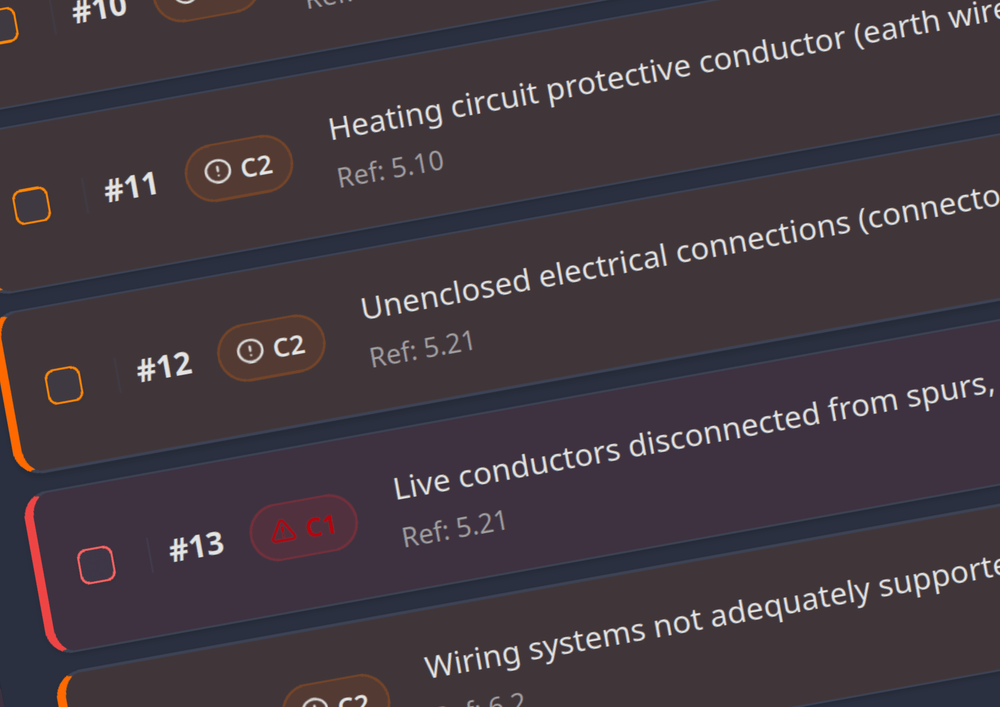
Picture with various EICR codes
If coding is vague, the whole report gets weak.
Most callbacks and disputes are not because someone forgot the code letters. They happen because the reasoning behind the code was never stated clearly enough to stand up later.
This guide is a practical reset. What each code usually means, how to prioritise action, and how to keep your EICR notes defensible.
Quick summary
| Code | Plain-English meaning | Urgency |
|---|---|---|
| C1 | Danger present | Immediate make-safe action |
| C2 | Potentially dangerous | Urgent remedial action |
| C3 | Improvement recommended | Improvement, not immediate danger |
| FI | Further investigation required | Investigate before signing off safety |
Use this as practical guidance, then verify your final coding decision against current recognised guidance and installation context.
Where this coding framework comes from
Electrical Safety First's Best Practice Guide 4 is built around using C1, C2, C3 and FI when recording observations in EICR work. It is focused on domestic and similar installations, while still being useful in similar scenarios elsewhere.
So the framework is familiar for a reason, it gives a shared language for risk and action priority.
What each code means in practice
C1, danger present
Treat C1 as a make-safe-now situation.
If someone can be put at immediate risk, do not leave it as a paperwork note for later. Isolate, make safe, document clearly, then set out what permanent remedial work is needed.
C2, potentially dangerous
C2 is not theoretical. It is the category for issues that are not immediate active danger in that exact moment, but could become dangerous and must be dealt with urgently.
Do not let C2 drift because the installation still appears to be operating.
C3, improvement recommended
C3 means improvement is advisable, but the observation is not being coded as immediate or potentially dangerous in current conditions.
The mistake here is turning every non-ideal point into C2. That kills trust in your coding and muddies remedial priorities.
FI, further investigation required
FI is for uncertainty that matters to safety.
If the evidence in front of you is not enough to reach a safe, defensible code, FI is often the honest answer. It should come with a clear note on what must be investigated and why.
Practical triage after the inspection
Use a clean order of operations:
- Make safe any C1 risks immediately.
- Raise urgent remedial actions for C2 items.
- Define investigation scope and owner for every FI item.
- Record C3 improvements separately so they do not dilute urgent works.
- Re-test and close out with explicit notes, not vague "rectified" wording.
That sequence keeps engineering judgement and reporting discipline aligned.
Common coding mistakes
1) Treating C3 like a soft C2
If you blur those lines, clients stop understanding risk priority.
2) Using FI as a parking bay
FI is not "not sure yet" admin. It is a safety-relevant uncertainty that needs a defined investigation path.
3) Writing defect text without decision logic
Your future self, the client, or another inspector should be able to see why the code was chosen from the note itself.
4) Overstating certainty where context changes the answer
Some observations depend heavily on installation context and compensating factors. If certainty is limited, say so clearly.
Action-priority table for reports
| Code | Report action | Management action |
|---|---|---|
| C1 | record immediate danger and make-safe action taken | urgent escalation and immediate permanent remedial plan |
| C2 | record risk and required urgent remedial work | schedule urgent rectification and verify completion |
| FI | record uncertainty and exact investigation needed | assign investigation owner/date before close-out |
| C3 | record recommendation and benefit of improvement | roll into planned improvement programme |
What this means for TestFast users
Good coding is not just about inspection quality. It is also about report quality.
If your observation text and code choice are consistent, the whole workflow is cleaner, remedials are easier to track, and handover conversations are far less messy. That is exactly where tools like TestFast EICR software help.
Final note on confidence
This article keeps wording practical and conservative on purpose.
Use it as a working guide, then check current recognised guidance before final sign-off decisions where context is borderline.
Further reading
Ready to transform your EICR workflow?
Join hundreds of UK electricians who are saving hours on every report with TestFast.