Social Rented Sector EICR: New Electrical Safety Rules for Housing Associations and Councils
A practical England guide to social rented EICR rules and deadlines.

Written by
Michael Adrian
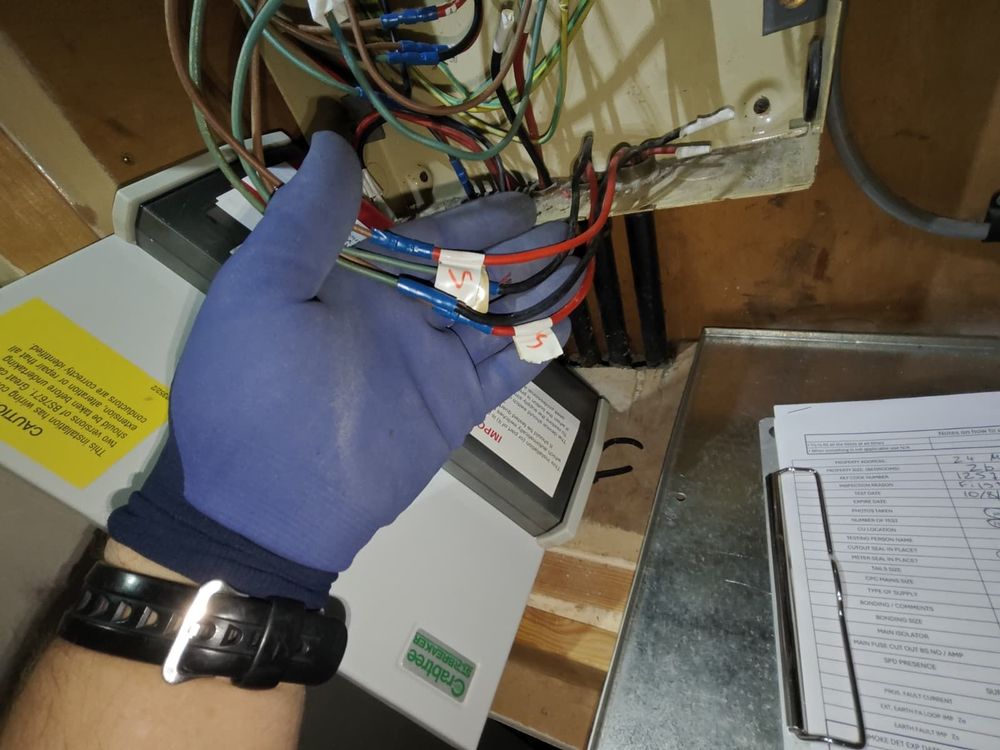
Connected cables under consumer unit
Social Rented Sector EICR: New Electrical Safety Rules for Housing Associations and Councils
If you manage social housing in England, the first electrical-safety deadline is 1 November 2026. That is the date by which the first required installation inspection and test, plus the applicable check of landlord-provided electrical equipment, must be completed for the transitional group of existing tenancies.
This is not just an EICR booking exercise. You need to know which homes are in scope, which records are separate, what happens when access fails, how remedial work is closed out, and whether your evidence can support the regulator’s BS06 measure.
This guide covers the England-specific rules and turns them into a practical programme for councils, housing associations, registered providers and contractors delivering the work.
Quick summary
- The 2025 amendment extended the Electrical Safety Standards in the Private Rented Sector (England) Regulations 2020 to the social rented sector in England.
- For specified tenancies granted before 1 December 2025 to a registered provider, the first inspection and test must be completed before 1 November 2026.
- 1 May 2026 is the date the substantive extension applies to that transitional cohort. It is not the completion deadline for the first round.
- The EICR covers the fixed electrical installation. Landlord-provided portable or movable equipment is handled through a separate electrical-equipment check and ISIT record.
- Existing tenants normally receive the installation report within 28 days of the inspection. New tenants must receive it before occupation. A local council must receive it within 7 days of a written request.
- C1, C2 and FI findings need action. Remedial or further investigative work must be completed within 28 days, or sooner if the report says so.
- BS06 is a reporting measure. It does not create a new inspection frequency or replace the underlying legal duties.
What changed for social rented housing in England?
The Electrical Safety Standards in the Private and Social Rented Sectors guidance explains the extension of the 2020 regime. The legal source is the Electrical Safety Standards in the Private Rented Sector (England) (Extension to the Social Rented Sector) Regulations 2025.
The scope is England-specific. Do not lift this timetable and apply it automatically to a Scottish, Welsh or Northern Irish portfolio. Those nations have their own housing and electrical-safety frameworks.
The regulations generally concern rented homes where the tenant has a right to occupy the premises as their only or main residence and pays rent, including certain licences to occupy. Schedule 1 contains exclusions. Supported accommodation, care settings, hospitals, student halls, long leases and other edge cases need checking against the actual legal definition rather than being assumed in or out of scope.
For a provider with thousands of homes, the first job is therefore a stock and tenancy audit. The legal deadline only helps if the denominator is right.
The dates that matter: 1 May and 1 November 2026
The staged timetable is where people are most likely to get caught out.
| Date | What it means | What to evidence |
|---|---|---|
| 1 November 2025 | The 2025 amending instrument began to come into force in stages | The applicable legal basis and tenancy cohort |
| 1 December 2025 | The transitional cut-off for specified existing registered-provider tenancies | Tenancy start/grant date and provider status |
| 1 May 2026 | The substantive extension applies to the specified pre-1 December 2025 cohort | The home’s scope decision and programme status |
| Before 1 November 2026 | The first installation inspection and test, and applicable first equipment check, must be completed for that cohort | EICR, equipment record and remedial/access evidence |
New social tenancies granted after the transitional cut-off have their own application and handover requirements. Check the current tenancy date and the specific duty before occupation, rather than putting every home into the same “November deadline” bucket.
The practical warning is simple: 1 May was not permission to wait until 1 November, and 1 May was not the completion deadline. Treat 1 November as the hard programme date for the transitional stock and work backwards from it.
What the EICR covers
The EICR is the inspection and test of the fixed electrical installation. That includes the wiring, socket-outlets, light fittings, consumer unit and permanently connected equipment such as showers and extractors.
Where specialist circuits form part of the installation, they need to be considered too. That can include circuits serving solar PV or battery storage. The qualified person carrying out the inspection will decide the appropriate inspection and testing scope and record the result against the installation.
The legal baseline is inspection and testing by a qualified person at least every five years. Five years is a maximum interval, not a target that overrides the report. If the report gives a shorter next-test period, follow that. A provider’s contract or internal policy may also require a shorter cycle.
The output is more than a pass/fail label. Keep the completed report, the inspection date, the next-test date, the property and tenancy identifiers, the person or contractor responsible, and any findings that need follow-on work.
For a short explanation of C1, C2, C3 and FI, link to what C1, C2, C3 and FI mean on an EICR.
The separate check for landlord-provided electrical equipment
This is not the same as the EICR.
For covered social landlords, electrical equipment provided by the landlord under the tenancy needs its own check at least every five years by a qualified person, using visual inspection and/or testing as necessary. The result is recorded in an ISIT record.
Examples in the government guidance include cookers, fridges and microwaves. The exact inventory depends on what the landlord has supplied. A tenant’s own appliance is not automatically pulled into the landlord-provided-equipment duty just because it is in the property.
“PAT testing” is the search term many people use, but it is safer to use the statutory idea: check the relevant landlord-provided equipment and retain the correct record. Do not create a blanket programme for every appliance in every home without first establishing ownership and scope.
If equipment is unsafe, the landlord must tell the tenant immediately and repair, replace or make it safe as soon as reasonably practicable, and no later than 28 days after the check. Before a new tenancy, it must be safe before occupation.
The useful portfolio split is:
| Item | Record or action |
|---|---|
| Fixed wiring, sockets, consumer unit and permanently connected equipment | EICR and any remedial or investigative work |
| Landlord-provided portable or movable equipment | Electrical-equipment check and ISIT record |
| Tenant-owned appliance | Not automatically part of the landlord-provided-equipment duty |
| Unsafe installation or equipment | Make safe, complete required work, retain confirmation and update the record |
What must be handed over, and when?
The report is part of the compliance evidence. It needs to reach the right person, not just sit in a contractor’s inbox.
- An existing tenant must receive a copy of the installation report within 28 days of the inspection and test.
- A new tenant must receive the report before occupying the property.
- A prospective tenant must receive it within 28 days of a written request.
- The local council must receive it within 7 days of a written request.
- Keep the current report or record and pass it to the next inspector or checker.
The equipment record has related but not identical handover and request rules. Keep EICR and equipment evidence as separate record types even when the same contractor completes both jobs.
At minimum, a provider should be able to retrieve the property identifier, tenancy cohort, inspection or check date, report/record status, findings, remedial owner, completion evidence, and distribution history. “The PDF exists somewhere” is not a reliable portfolio control.
C1, C2, C3 and FI: turn findings into action
The codes are a useful workflow trigger, but the inspecting person’s technical judgement remains central.
- C1: danger present.
- C2: potentially dangerous.
- C3: improvement recommended.
- FI: further investigation required.
C1 and C2 make the report unsatisfactory for continued use. C3 alone does not make it unsatisfactory. FI means the investigation or action specified by the report cannot be ignored.
Where remedial or further investigative work is required, complete it within 28 days or within any shorter period stated in the report. Then retain the updated report, written confirmation or other appropriate certification and the evidence showing who completed the work and when.
A practical loop looks like this:
- Record the observation against the home and report.
- Make any immediate danger safe and assign the follow-on work.
- Set the report deadline, or the shorter deadline stated by the qualified person.
- Complete the remedial or investigative work.
- Obtain the corrected paperwork or written confirmation.
- Update the property record and distribute the required evidence.
- Escalate anything still open before it becomes an overdue item in the portfolio report.
Do not use a spreadsheet status of “job raised” as proof that the legal duty is closed. The close-out evidence is what matters.
Enforcement and BS06 reporting
Local councils can serve remedial notices and, in defined circumstances, arrange remedial work themselves. Costs may be recoverable from the landlord where the statutory conditions are met, and appeal routes apply. This is not an automatic right to enter every property or bypass the relevant notice and consent requirements.
For offences from 1 May 2026, councils may impose a financial penalty of up to £40,000 for specified breaches. That is a maximum cap, not an automatic fine per home, per EICR or per finding.
There is also a reporting consequence for social landlords. The Regulator of Social Housing’s Tenant Satisfaction Measures: Technical Requirements 2026 includes BS06, the proportion of homes for which all required electrical safety checks have been carried out.
BS06 is management information. It does not change the five-year maximum interval, make a C3 a failure, or replace the underlying inspection, equipment and remedial duties. It does mean that your property denominator, current records and definition of “all required checks” need to reconcile. The current TSM Direction sets the reporting requirements by provider size and reporting year, so check the live direction when preparing the return.
A practical readiness plan for councils and housing associations
1. Build the in-scope stock list
Start with tenancy and provider data, not contractor availability. Record the tenancy grant date, provider status, property identifier, accommodation type, known exclusions, latest EICR date, next-test date and whether landlord-provided equipment is present.
Flag homes where the legal position is uncertain. Supported or specialist accommodation may have additional requirements, exclusions or contractual duties. A clear exception queue is better than silently mixing uncertain homes into the normal count.
2. Run two evidence tracks
Schedule the fixed-installation EICR and the landlord-equipment check as related but separate tasks. They can be completed in one visit where appropriate, but they should not become one ambiguous record.
Your evidence matrix should include:
- EICR report and next-test date
- equipment check and ISIT record, where applicable
- C1/C2/FI remedial or investigative action
- completion certificate, updated report or written confirmation
- tenant and council distribution history
- access attempts, appointments, cancellations and escalation
- contractor, operative and audit metadata
3. Plan capacity around the whole job
The programme is inspect, issue, remediate, verify, evidence and report. If you only count inspection slots, the back end of the programme will jam when C1, C2, FI and no-access cases arrive together.
Set work ownership for each stage. Contractors need a clear handoff for reports and findings. The landlord team needs a clear owner for access escalation, remedial approval, evidence checks and tenant communication.
4. Treat access as a tracked compliance issue
Keep a history of appointment offers, failed visits, tenant contact, reasonable adjustments, escalation and the next action. An access problem is not closed because one appointment was missed.
The Housing Ombudsman’s Leicester City Council decision shows why inspection, access and follow-on work need an audit trail. It is a case-specific example, not a universal performance benchmark.
5. Make the dashboard reconcile
A useful board or regulator view should show the total in-scope homes, homes with a current EICR, homes with the applicable equipment record, overdue or no-access homes, open C1/C2/FI or equipment actions, evidence awaiting verification, and the BS06 numerator and denominator.
Do not invent access-rate targets or claim that a dashboard itself creates compliance. The point is to expose the gaps early enough for someone to act.
Where TestFast fits
TestFast belongs in the workflow layer, after the legal scope and evidence rules are clear. For a high-volume EICR programme, it can help electrical contractors and service teams keep property and job identifiers, inspection dates, report status, findings, remedial assignments and completion evidence in one traceable workflow.
That is the useful bit. It does not replace the qualified person, the landlord’s statutory records or the provider’s asset system, and it should not be presented as automatically calculating BS06 unless that capability has been confirmed against the live product.
See EICR workflow software or software for electrical contractors if you are coordinating inspections and remedial work across a portfolio.
Common mistakes to avoid
- Treating 1 May 2026 as the first-round completion deadline.
- Assuming every social-housing home is in scope without checking the tenancy and accommodation details.
- Treating the EICR as the record for landlord-provided portable equipment.
- Calling every appliance in a home a landlord-equipment duty, including tenant-owned appliances.
- Treating a C3 as the same as a C2, or treating “job raised” as remedial completion.
- Keeping reports without a property denominator, distribution history or close-out evidence.
- Assuming an access failure is somebody else’s problem.
- Describing the £40,000 maximum as a standard fine per property.
- Treating BS06 as a new inspection rule rather than a management-information measure.
The practical takeaway
For the transitional stock, 1 November 2026 is the date to work back from. Build the in-scope list, separate EICR and equipment records, book qualified capacity, track access and remedials, and make sure every closed item has evidence behind it.
The inspection is one event. Social-housing electrical compliance is the chain around it: scope, appointment, report, action, confirmation, handover and portfolio evidence. If any link is missing, the PDF alone will not save you.
Ready to transform your EICR workflow?
Join hundreds of UK electricians who are saving hours on every report with TestFast.