EICR Remedial Work: What Happens When Your Inspection Fails
Failed EICR? A practical guide to remedial work, deadlines and closing the job.

Written by
Michael Adrian
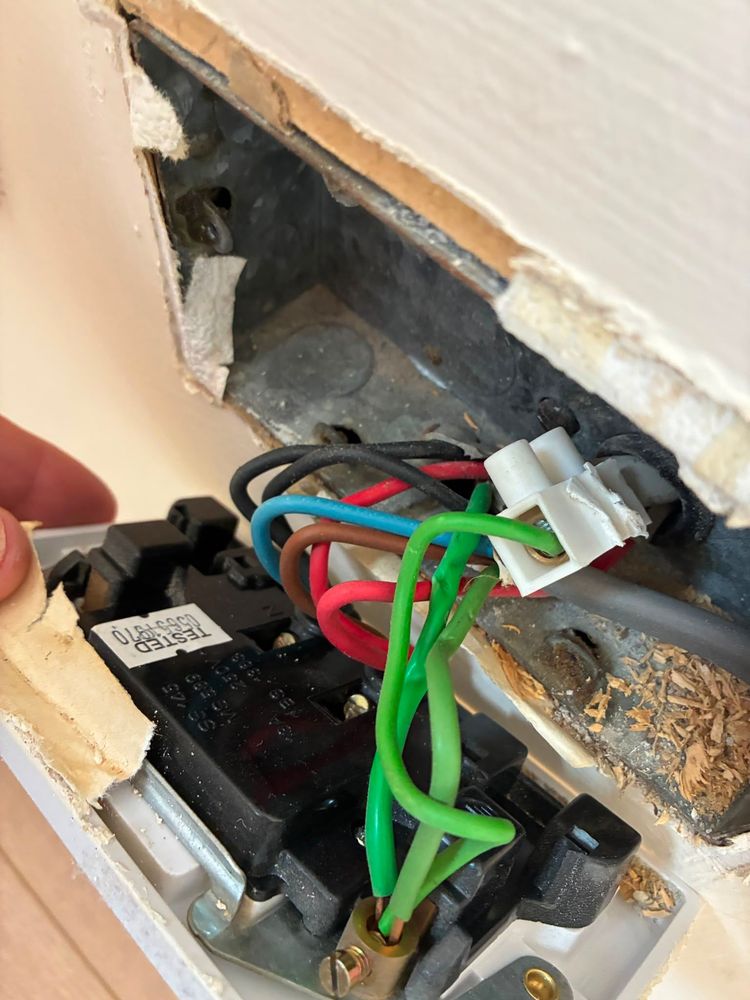
Wires extended behind socket
EICR Remedial Work: What Happens When Your Inspection Fails
An unsatisfactory EICR is not the end of the job. It is the point where the inspection findings need turning into safe, traceable remedial work.
The first thing to check is the observation code. C1, C2 and FI need action. C3 is an improvement recommendation and, by itself, does not make the report unsatisfactory.
This guide sets out the sensible order of operations: read the report properly, deal with immediate risk, brief the remedial electrician, meet the relevant deadline, and close the job with the right evidence. The 28-day legal process described below is for private and social rented properties in England. Do not treat it as a single UK-wide landlord rule.
Quick summary
When an EICR comes back unsatisfactory:
- Read every observation, limitation and recommendation. Do not work from the words “failed EICR” alone.
- Separate anything that needs making safe now from work that can be planned.
- Give the full report to a competent electrician and ask for a written scope.
- In England, complete required remedial or further investigative work within 28 days, or sooner if the report gives a shorter period.
- Get the appropriate completion evidence, send the required records and confirmation, and retain the full audit trail.
The observation code is a risk classification. It is not a quote, a method statement or a complete description of the repair.
First, check what “unsatisfactory” means
The report should tell you why the installation is unsatisfactory and what needs investigating or correcting. The common codes mean:
| Code | Plain-English meaning | What to do next |
|---|---|---|
| C1 | Danger present. Risk of injury. | Make the situation safe immediately where practicable. This may include isolation or another immediate safety control, depending on the finding. |
| C2 | Potentially dangerous. | Arrange remedial work promptly and make sure the electrician has the full observation details. |
| FI | Further investigation required without delay. | Arrange the investigation. Do not assume the eventual repair, cost or code without the evidence. |
| C3 | Improvement recommended. | Record and consider the improvement. C3 alone does not make the report unsatisfactory. |
These labels describe the condition found during the inspection. They do not automatically prescribe one repair for every installation. The same broad defect category can need different action depending on the installation, the evidence and the risk.
That is why “it has a C2” is not enough information to price a job. The observation text, location, circuit details and any limitations matter.
What to do when you receive the report
Start with the report itself, not a contractor’s summary of it.
1. Read every observation and limitation
List each C1, C2 and FI observation. Note where it is, which circuit or item it relates to, and whether the inspector recorded a limitation or recommended further investigation.
Do the same with C3 items. They are not a failed result on their own, but they may still be useful improvement work while access and an electrician are already arranged.
2. Separate immediate safety from planned work
A C1 finding needs the immediate-risk question answered first: what can be made safe now, where practicable?
That is different from arranging a larger remedial programme. A landlord or electrician should be able to tell from the record which items were isolated, made safe, investigated or left for planned completion. Do not let a long quotation hide an urgent safety issue.
3. Query anything that is not actionable
If an observation is unclear, ask the inspecting electrician to explain what was observed and what further information is needed. This is especially important for FI items and observations affected by access or testing limitations.
The aim is not to rewrite an inconvenient report. Do not erase, downgrade or reword observations simply to turn an unsatisfactory result into a satisfactory one.
4. Keep the original report intact
Save the original EICR before any work starts. Keep the dated report, photographs where relevant, emails, access attempts, quotations, invoices, certificates and follow-up records together.
That gives the landlord and the remedial electrician a shared starting point, and it leaves a clear record of what happened if the work takes longer than expected.
How to arrange EICR remedial work
Give the remedial electrician the complete EICR, not just a list copied into a text message. The full report may contain information that changes the scope, including limitations, circuit references and related observations.
Ask for a written scope that sets out:
- the observation or observations being addressed;
- the proposed work and any further investigation;
- what is excluded;
- access assumptions and any dependency on another person or organisation;
- how affected circuits or equipment will be left safe;
- what testing and certification will be provided at completion.
The report code does not define the entire job. For example, an observation involving earthing, bonding, RCD protection, damaged accessories or a circuit fault may need inspection of connected parts before the electrician can confirm the final scope.
Common work categories include:
- RCD protection issues;
- earthing and bonding defects;
- damaged or exposed live parts and cabling;
- high earth-fault loop impedance or disconnection issues;
- insulation resistance, continuity, polarity or borrowed-neutral faults;
- overheating or damaged accessories;
- unsafe installations in special locations.
These are examples of areas that can lead to remedial work. They are not automatic code mappings. Whether a particular observation is C1, C2, C3 or FI depends on the installation and the inspector’s assessment.
The 28-day remedial-work rule in England
For landlords covered by the England electrical safety regulations, where the report shows that remedial or further investigative work is necessary, the work must be completed within 28 days, or within any shorter period stated in the report.
That makes the report date and any stated deadline worth recording immediately. Do not assume that “28 days” means there is always a full 28 days available. The report may specify a shorter period, and an immediate safety issue still needs an immediate response.
After the work or investigation, the landlord must provide the relevant report or record and written confirmation that the work was carried out to the tenant and the local council within the required period. The acceptable evidence depends on the work. It can include a satisfactory EICR, an Electrical Installation Certificate, a Minor Electrical Installation Works Certificate, or other appropriate electrical certification.
Do not promise that one particular certificate is always enough. The electrician needs to identify what work was done and which certification is appropriate for that work.
What if the work cannot be finished in 28 days?
Some jobs involve complex work, a dependency on an energy supplier, access problems or tenant-specific circumstances. If completion is delayed for a legitimate practical reason, keep clear records and take reasonable steps to complete the work as soon as possible.
Record:
- the original report and deadline;
- the risk-control steps taken;
- who was contacted and when;
- access attempts and agreed appointments;
- the reason for the delay;
- the revised programme;
- the final completion and certification evidence.
This is not a way to ignore the deadline. It is a way to show what happened, what was done to manage the risk, and why the work could not reasonably be completed sooner.
If the situation affects a council duty or requires escalation, get the relevant local guidance rather than relying on a generic UK checklist.
What paperwork closes the job?
The job is not closed just because someone says the repair is done.
Close-out should normally include:
- A record of the remedial work or further investigation completed.
- The appropriate certificate or updated report for that work.
- Any test results or supporting evidence that belongs with the certificate.
- Written confirmation and copies sent to the people or organisation that must receive them.
- An updated record showing which observations are complete and which, if any, remain open.
For an England landlord, the original EICR, remedial records and confirmation should be retained and provided as required by the regulations. Keep the quotation and communications as well, particularly where there was a delay, a change of scope or a disagreement about access.
The cleanest record is one that lets another competent person answer three questions quickly:
- What was found?
- What was done about it?
- What evidence proves the work was completed?
Common mistakes after a failed EICR
Treating every C3 as a failure
C3 means improvement recommended. It should be recorded and considered, but C3 alone does not make the report unsatisfactory.
Assuming every C2 is the same job
C2 is a risk classification, not a standard repair package. The observation wording and installation context still need to be understood.
Giving the remedial electrician only the headline
“The EICR failed” is not a useful scope. Send the full report, including limitations and circuit references.
Assuming a defect category always receives one code
Missing RCD protection, a plastic consumer unit, damaged wiring or an earthing issue should not be treated as automatic code decisions without considering the installation and the evidence.
Chasing a certificate without closing the observation
A document is useful only if it relates to the work completed. Make sure the record says what was investigated, repaired or made safe, and whether the original observation has been resolved.
Treating the England deadline as a UK-wide rule
The 28-day process described in the England guidance is not a universal landlord deadline for Scotland, Wales and Northern Ireland. Check the rules that apply to the property.
When an EICR cannot be repaired immediately
The first priority is control of immediate risk. Depending on the finding and the electrician’s assessment, that may involve isolation, making equipment safe, restricting use or another temporary control.
The exact response is installation-specific. This article cannot tell you how to make a particular defect safe, and a C1 or C2 label is not a substitute for the electrician’s assessment.
If the permanent work needs a specialist, a supplier, access arrangement or a larger programme, write down the dependency and the next action. A vague note saying “awaiting contractor” is weak evidence. A dated appointment request, access record, risk-control note and written programme are much more useful.
Where the situation falls under a local authority or other duty-holder process, follow the relevant guidance and escalate when necessary.
How TestFast helps track remedial work
The technical decision stays with the inspecting or remedial electrician. TestFast does not decide whether an observation is C1, C2, C3 or FI, and it does not replace inspection, certification or legal advice.
Where it can help is the admin around the job. You can use a workflow to record the failed report, turn observations into actions, assign responsibility, track status, and keep completion evidence with the relevant record.
That matters when a failed EICR becomes several separate jobs. Each action needs an owner, a planned date and a clear close-out status. The report, remedial record and certificate should not be scattered across inboxes and phone photos.
For the code itself, link to EICR Codes Explained and the Code Breaker. For the wider workflow, see EICR software. Those tools and references support the record-keeping process; they do not make the electrician’s technical judgement for them.
FAQs
Is C3 an EICR fail?
No. C3 means improvement recommended. C3 alone does not make the report unsatisfactory, although the improvement may still be worth planning.
Is every C2 repair due within 28 days across the UK?
No. The 28-day remedial-work process described in this guide is the England landlord process. Do not apply it automatically to properties in Scotland, Wales or Northern Ireland. Also check the report for a shorter stated deadline.
Can a landlord arrange a second opinion?
A landlord can ask another competent electrician to review the findings or quote for the work. The original report should remain intact, and a second opinion should clarify the evidence rather than simply remove an inconvenient observation.
What certificate proves remedial work is complete?
It depends on the work carried out. Possible evidence includes a satisfactory EICR, an Electrical Installation Certificate, a Minor Electrical Installation Works Certificate or other appropriate electrical certification. The electrician should confirm what applies.
Can remedial work be carried out by the original inspector?
It can be, provided the electrician is competent and able to carry out the work. The important point is that the remedial work is properly scoped, completed, tested and documented. A different electrician may also be used.
The close-out checklist
Before marking the job complete, check that you have:
- the original EICR;
- every C1, C2 and FI observation identified;
- immediate safety actions recorded;
- a written remedial scope;
- the completion or investigation record;
- the appropriate certificate or updated report;
- evidence sent to the required recipient;
- open actions either closed or assigned a documented next step;
- the full record stored together.
The useful outcome of remedial work is not just a new piece of paper. It is a safe installation, a clear explanation of what was done, and a record that stands up when someone needs to check it later.
Ready to transform your EICR workflow?
Join hundreds of UK electricians who are saving hours on every report with TestFast.