Max Zs Values 18th Edition Table
If want the right max Zs figure fast, this is where people usually get tangled.

Written by
Michael Adrian
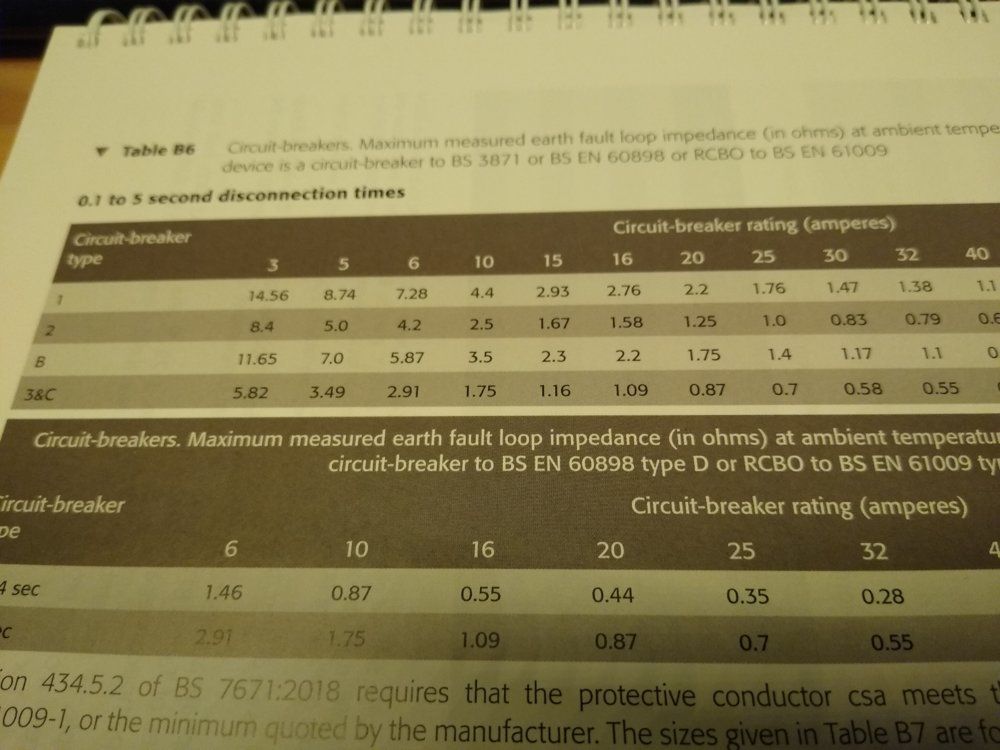
Max Zs Values Book
If you are checking loop readings and you just want the right max Zs figure fast, this is where people usually get tangled.
The problem is not just finding a number. It is knowing whether you should be looking at the BS 7671 table value, a temperature-adjusted comparison value for testing, or the manufacturer’s own data for the device in front of you.
This guide is the practical version. What max Zs values mean, when the common 100% and adjusted values are being used, where generic tables stop being enough, and what to do when a reading is high.
Quick summary
- Max Zs is the maximum permitted earth fault loop impedance for the protective device and required disconnection time being used.
- For ADS, your measured Zs needs to be at or below the permitted value for that device.
- BS 7671 tabulated values and the lower comparison values used for testing are not the same thing. Mixing them up is where a lot of bad calls start.
- Generic public tables are useful for quick checks, but they do not override manufacturer-specific data.
- If you are dealing with MCCBs or any device where maker data is available, use that data wherever possible.
What max Zs actually means
Max Zs is the highest earth fault loop impedance that still allows the protective device to disconnect within the required time.
In plain English, it is the limit you compare against when you are checking whether fault protection by automatic disconnection of supply is going to work as intended.
That is why max Zs matters in both design and inspection. It is not just a table for the sake of a table. It is tied directly to whether the breaker or fuse will clear the fault quickly enough.
Full max Zs lookup table
This is the defensible route for the numeric table.
For BS EN 60898 MCBs and the overcurrent characteristics of BS EN 61009 RCBOs, the values below can be derived directly from the Appendix 3 formula reflected in the IET source material:
Zs = (U0 × Cmin) / Ia
Using the current BS 7671 approach discussed by the IET:
- U0 = 230 V
- Cmin = 0.95
- Type B uses Ia = 5 × In
- Type C uses Ia = 10 × In
- Type D uses Ia = 20 × In
That gives a 100% tabulated value of 218.5 / Ia. The adjusted comparison value is shown here as 80% of that figure, rounded to two decimal places for quick on-site comparison.
Type B MCB and RCBO max Zs values
| Rated current | 100% max Zs (Ω) | 80% comparison value (Ω) |
|---|---|---|
| 6 A | 7.28 | 5.82 |
| 10 A | 4.37 | 3.50 |
| 16 A | 2.73 | 2.18 |
| 20 A | 2.19 | 1.75 |
| 32 A | 1.37 | 1.10 |
| 40 A | 1.09 | 0.87 |
| 50 A | 0.87 | 0.70 |
| 63 A | 0.69 | 0.55 |
Type C MCB and RCBO max Zs values
| Rated current | 100% max Zs (Ω) | 80% comparison value (Ω) |
|---|---|---|
| 6 A | 3.64 | 2.91 |
| 10 A | 2.19 | 1.75 |
| 16 A | 1.37 | 1.10 |
| 20 A | 1.09 | 0.87 |
| 32 A | 0.68 | 0.54 |
| 40 A | 0.55 | 0.44 |
| 50 A | 0.44 | 0.35 |
| 63 A | 0.35 | 0.28 |
Type D MCB and RCBO max Zs values
| Rated current | 100% max Zs (Ω) | 80% comparison value (Ω) |
|---|---|---|
| 6 A | 1.82 | 1.46 |
| 10 A | 1.09 | 0.87 |
| 16 A | 0.68 | 0.54 |
| 20 A | 0.55 | 0.44 |
| 32 A | 0.34 | 0.27 |
| 40 A | 0.27 | 0.22 |
| 50 A | 0.22 | 0.18 |
| 63 A | 0.17 | 0.14 |
What this table does and does not cover
This numeric table is defensible for the common BS EN 60898 / BS EN 61009 overcurrent characteristics because it is formula-derived from the IET-backed BS 7671 method rather than copied from a third-party chart.
It does not settle every broader “max Zs table” use case on its own. Fuses, MCCBs, and other device families still need either their own verified table source or manufacturer-specific data.
| Protective device / reference group | Use this table as your starting point? | Main caveat |
|---|---|---|
| BS EN 60898 Type B, C and D MCBs | Yes | Be clear whether you are comparing against the 100% figure or the adjusted testing value |
| BS EN 61009 RCBO overcurrent characteristics | Yes, where the overcurrent characteristic matches the type shown | Confirm the device basis and published data |
| BS EN 60947-2 devices including MCCBs | No | Use manufacturer data wherever possible |
| Rewirable fuses and cartridge fuses | No | Use the correct verified fuse table instead of this MCB/RCBO table |
Source route used for the figures
- IET note on the reduction in maximum Zs values, which confirms the Cmin-based method and gives a 32 A type B example of 1.37 Ω.
- Pro Certs explainer, used only as a secondary cross-check that the same formula and 80% comparison convention are what trade readers commonly expect.
That source path supports publishing these MCB/RCBO figures as an original, formula-derived table. It does not by itself support claiming that this page reproduces the entire BS 7671 or Electrical Safety First chart range.
100% vs adjusted max Zs values
This is the bit that catches people out.
BS 7671 Chapter 41 tables give maximum Zs values at operating temperature. That is why those headline figures are not always the same as the lower comparison values shown in the On-Site Guide or Guidance Note 3 for testing conditions.
So when people talk about 100% values and 80% values, they are usually trying to separate two different jobs:
- the full tabulated maximum permitted Zs value for the device, and
- the lower comparison value commonly used when checking measured readings during testing.
That does not mean you should reduce every figure by habit and stop thinking. The safer point is this: make sure you know which basis your reference table is using before you compare your measured result against it.
If you mix the two up, you can end up passing a borderline reading you should have questioned, or failing one without being clear why.
When to use BS 7671 tables and when to check manufacturer data
A generic table is a quick starting point. It is not the whole job.
Appendix 3 guidance, as reflected in the IET material in the enrich pack, is clear on the main caution: maximum earth fault loop impedance values vary between protective devices and between manufacturers.
That matters most when you move beyond the common quick-reference breaker chart mindset.
Use a generic table as a starting point when
- you are dealing with common device families where tabulated guidance is routinely used for quick checks
- you are making a first-pass comparison and still know exactly what basis the figure uses
- the device in front of you does not have more specific maker data that should override the generic reference
Go to manufacturer data when
- the device maker provides specific max Zs figures
- you are working with BS EN 60947-2 devices or MCCB-type gear
- the protection characteristics are not well served by generic public charts
- you need a defensible figure for design, verification, or report sign-off rather than a rough lookup
If manufacturer data exists, that is usually the stronger basis.
Common disconnection times electricians actually care about
The enrich pack supports two common TN-system examples that are worth surfacing because they shape which max Zs figure you are even looking for.
| Circuit context | Common TN disconnection time example | Why it matters |
|---|---|---|
| Final circuits up to 63 A with a socket-outlet | 0.4 s | This is the common fast-disconnection scenario people are usually thinking about when checking ordinary final circuits |
| Distribution circuits | 5 s | Different time, different permitted Zs basis, so do not assume the same lookup logic as a socket circuit |
That is not an exhaustive disconnection-time guide for every arrangement. It is the practical reminder that the correct max Zs figure depends on the circuit and protective arrangement, not just the breaker label.
A simple decision path on site
When you are checking Zs on a job, the clean process is:
- Identify the actual protective device and circuit type.
- Confirm the disconnection time you are working to.
- Decide whether your reference is a BS 7671-style tabulated value, an adjusted comparison value for testing, or manufacturer data.
- Compare like with like.
- Record the basis of your max Zs figure clearly, not just the measured result.
That last point matters more than people think. If someone reviews the cert later, they should be able to see what limit you were working to and why.
What to do if measured Zs is too high
Do not jump straight to one explanation.
A high or borderline reading can mean different things depending on the circuit, the device, and the basis of the figure you compared it against.
Start with the obvious checks:
- confirm you used the right max Zs basis
- confirm the actual protective device details
- check connections and terminations
- consider parallel paths and measurement conditions
- check whether manufacturer data changes the limit you should be using
If the reading is still genuinely high, then you are into fault-finding or remedial territory, not just table-reading.
Where a calculator or reporting tool helps
For day-to-day work, a quick max Zs calculator is often the easiest way to avoid mixing up reference values and comparison logic.
That is also where clear recording in TestFast EICR software helps, especially when you want the chosen basis and the measured reading to make sense later in the cert or report rather than living only in your head.
Final takeaway
A max Zs table is useful, but the number on its own is not the whole story.
The real job is knowing which figure applies, whether you are comparing against a full tabulated value or an adjusted testing value, and when generic charts stop being good enough because the manufacturer’s data should take over.
That is what keeps the decision defensible.
Ready to transform your EICR workflow?
Join hundreds of UK electricians who are saving hours on every report with TestFast.